


Page 16 - iMath K to 12 Curriculum Series]
P. 16
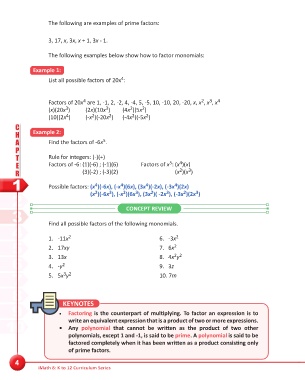
The following are examples of prime factors:


                    3, 17, x, 3x, x + 1, 3x - 1.

                    The following examples below show how to factor monomials:


              Example 1:
                                                4
                    List all possible factors of 20x :


                                                                                   3
                                                                               2
                                 4
                    Factors of 20x  are 1, -1, 2, -2, 4, -4, 5, -5, 10, -10, 20, -20, x, x , x , x 4
                                          3
                           3
                                                    2
                                                        2
                    (x)(20x )     (2x)(10x )     (4x )(5x )
                                                          2
                                                    2
                                     2
                           4
                                           2
                    (10)(2x )     (-x )(-20x )   (-4x )(-5x )
       C
       H      Example 2:
       A            Find the factors of -6x .
                                         5
       P
       T            Rule for integers: (-)(+)
                                                                       4
                                                                   5
       E            Factors of -6: (1)(-6) ; (-1)(6)     Factors of x : (x )(x)
                                                                       2
                                                                          3
       R                         (3)(-2) ; (-3)(2)                   (x )(x )
      1             Possible factors: (x )(-6x), (-x )(6x), (3x )(-2x), (-3x )(2x)
                                                                     4
                                                          4
                                      4
                                                4
                                                            2
                                                      3
                                                 2
                                            3
                                      2
                                                                        2
                                                                             3
                                                                  3
      2                             (x )(-6x ), (-x )(6x ), (3x )( -2x ), (-3x )(2x )
      3                                           CONCEPT REVIEW
      4             Find all possible factors of the following monomials. 2
                            2
                                                               6.
                    1.  -11x
                                                                   -3x
      5             2.  17xy                                   7.  6x 2
                                                                     2 2
      6             3.  13x                                    8.  4x y
                         2
                    4.  -y
                                                                   3z
                                                               9.
      7             5.  5x y                                   10. 7m
                          3 2
      8
                          KEYNOTES
      9                 •  Factoring is the counterpart of multiplying. To factor an expression is to
                            write an equivalent expression that is a product of two or more expressions.
                        •  Any  polynomial  that  cannot  be  written  as  the  product  of  two  other
                            polynomials, except 1 and -1, is said to be prime. A polynomial is said to be
                            factored completely when it has been written as a product consisting only
                            of prime factors.
       4
                iMath 8: K to 12 Curriculum Series

